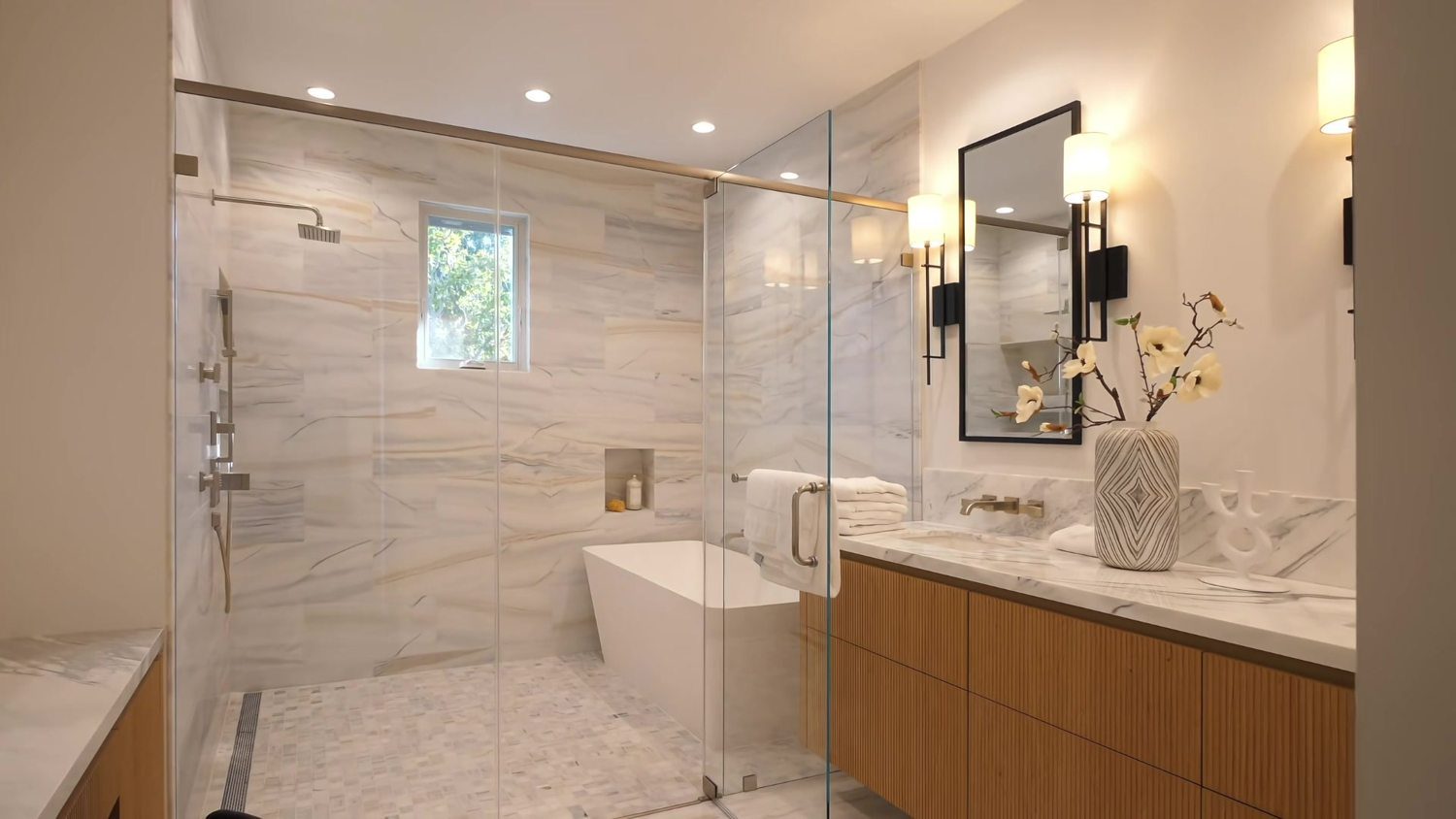
A basin looks simple until it reaches site: the tap holes do not match the faucet, the rim sits too high for the vanity, or the wall bracket was never rated for the weight. Basins and faucets are often bought from different factories, and nobody checks them against each other until installation day.
Key points
- Choose the mounting type first — wall-hung, countertop/vessel, semi-recessed or pedestal — because it drives the wall structure, vanity and waste position.
- Vitreous china is the default; fireclay, solid surface and stone resin solve specific problems but change weight and installation requirements.
- Confirm tap-hole count, spacing, diameter and deck thickness against the actual faucet before production.
- Send the factory a dimensioned cutout template or DXF for the vanity top, not a catalogue photo.
- Check waste thread, overflow, trap type and rim height before the plumbing rough-in is fixed.
- A pre-shipment inspection should check dimensions, glaze, edges, tap holes and packing — not just look at one photo of the box.
1. Start with the mounting type
The mounting decision is the hardest thing to change once the cabinetry and plumbing rough-in are final. Each type places different demands on the wall, the vanity and the waste connection.
| Type | Structural requirement | Vanity below | Best for |
|---|---|---|---|
| Wall-hung | In-wall carrier frame or reinforced studs; bracket rated for basin plus user lean | None or open shelf | Compact and barrier-free bathrooms |
| Countertop / vessel | Vanity counter cut to the exact basin footprint | Full vanity cabinet | Hotel vanities, villa ensuites |
| Semi-recessed | Counter or shelf at reduced depth | Shallow cabinet or none | Small ensuites, powder rooms |
| Pedestal | Floor-fixed column; no wall load | None — pedestal only | Traditional or guest bathrooms |
For a hotel floor, serviced apartments or a repeated villa layout, the mounting type is decided once and repeated across every bathroom. Wall-hung basins let a contractor standardise the carrier frame across rooms; vessel basins tie the installation to the vanity joinery, so a dimensional error in the basin batch becomes a cut-out problem in every unit.
2. Material, glaze and weight
Material determines weight, chip resistance and how the surface ages after years of hard water and cleaning chemicals. Vitreous china remains the default across most price points, but the alternatives each solve a specific problem.
| Material | Approx. installed weight | What it is good for | What to watch |
|---|---|---|---|
| Enamelled steel | 5 kg | Budget project work | Enamel chips expose bare steel to rust |
| Solid surface (acrylic resin) | 7 kg | Integrated vanity-and-basin counters | Lower heat tolerance; scratches can usually be sanded out |
| Vitreous china | 12 kg | Standard hotel, residential and villa projects | Edges can chip on impact; check glaze batch |
| Stone resin composite | 16 kg | Premium vessel and countertop basins | Weight affects wall brackets; confirm load rating |
| Fireclay | 15–18 kg | Farmhouse and apron-front styles | Dense body is heavy; exposed edges need protection |
Weight matters most for wall-hung installations. A bracket sized for a standard ceramic basin may be under-rated for a denser fireclay or stone-resin basin once a person leans on the rim. Ask for the actual unit weight, not the carton weight, and pass it to the installer before the carrier frame is set.
For ceramic bodies, ask which standard the glaze was tested against — for example GB/T 6952 in China, ASME A112.19.2 / CSA B45.1 in North America, or EN 14688 in the EU. For a multi-unit order, request matched-lot production and approve a colour chip: white glaze can shift tone from batch to batch.
3. Tap holes and faucet compatibility
The most common on-site failure in a basin order is a tap hole that does not match the faucet — a three-hole basin paired with a single-hole monobloc, a vessel basin with no holes but a deck-mounted faucet, or a widespread set whose centres are wider than the basin drilling.
- Hole count: 0, 1 or 3 holes, matching the faucet type.
- Centre-to-centre spacing: commonly 4 inch / 102 mm or 8 inch / 203 mm for three-hole sets.
- Deck thickness at the hole, because some faucets need a minimum thickness to seat the mounting nut.
- Hole diameter: confirm the required bore for commercial-grade valves.
- Template: send the faucet’s drilling template, not only its model number, to the basin factory.
Wall-mounted faucets remove the tap-hole question because the basin ships undrilled and the valve sits in the wall. That moves the coordination to the plumber, who needs the exact spout reach and basin depth to set the rough-in height correctly.
4. Matching the basin to the vanity and countertop
For drop-in and vessel basins, the countertop fabricator needs the exact footprint before the stone or solid-surface top is cut. A cut-out a few millimetres tight can crack a stone counter during fitting; one that is loose leaves a gap that sealant will not disguise.
- Request a dimensioned cut-out drawing or DXF from the factory, not a rendered product image.
- Confirm the rim profile: under-mount, self-rimming drop-in, or vessel with no counter cut-out.
- Ask for the production tolerance across the batch, not just the nominal size.
- Confirm the sealant specified for the counter material at the basin edge.
- Check that the tap and waste positions do not clash with the cabinet internals.
5. Waste, overflow and trap
Waste fittings are usually bought separately and are a frequent source of mismatch. Confirm the drain outlet thread size and pitch, and specify whether the waste is included with the basin.
- Drain thread: confirm against the waste fitting if sourced separately.
- Overflow: most basins have a cast overflow; some minimalist designs omit it, which may not suit the plumbing code or the faucet.
- Waste mechanism: pop-up, click-clack or plug-and-chain; specify what ships with the basin.
- Trap: bottle trap for exposed plumbing under vessel or pedestal basins, or a concealed P-trap inside a vanity.
6. Dimensions, rim height and installation drawings
Rim height is not a fixed number. It is the sum of the mounting height, the basin height and the counter or bracket position. Work it out before the vanity or wall frame is built.
| Mounting | What sets the final rim height | What to issue to site |
|---|---|---|
| Wall-hung | Bracket height plus basin height | Bracket datum, carrier frame type and finished floor level |
| Countertop / vessel | Vanity height plus basin height | Counter height, cut-out template and tap drill positions |
| Semi-recessed | Counter or shelf height plus projection | Depth of recess, support detail and waste position |
| Pedestal | Pedestal height plus basin | Floor fixing, supply and waste rough-in dimensions |
Issue a dimensioned elevation and plan for each bathroom type. On repeated hotel or villa layouts, number the typical rooms and confirm which ones vary; “standard bathroom” is not a specification if the floor levels or wall build-ups differ.
7. What to check before shipment
A basin QC report should go beyond a photo of the carton. Ask for the measurements and tests that matter to installation:
- Overall dimensions and tap-hole positions against the approved drawing.
- Glaze colour and surface defects under raking light.
- Rim flatness and edge condition; no chips on exposed edges.
- Drain hole and overflow function; waste thread compatibility.
- Unit weight against the wall-bracket specification.
- Packing: individual protection, carton strength, pallet or crate configuration.
Inspect a sample from each production batch, not one piece from the first batch. Ceramic firing and glaze vary by kiln load, and the piece that arrives on site may not be the one in the approval photo.
8. Packing and shipping
Ceramic basins are heavy and fragile. They should be individually wrapped, separated by dividers, and packed in a carton rated for the unit weight. For LCL shipments, ask for export-grade packing and a pallet configuration that can survive terminal handling; for FCL, still confirm carton stacking limits and container loading sequence.
If basins are ordered with vanities, tiles or tapware from other suppliers, consolidate them at one Foshan warehouse and photograph the packed pallets against the packing list. That photo set is often the only evidence available if a carton is crushed in transit.
Frequently asked questions
Wall-hung basins are common in mid-market and upper-mid hotel rooms because the carrier frame can be standardised across bathrooms. Countertop and vessel basins offer more design flexibility but tie the installation to the vanity cut-out, so tolerances must be controlled across the batch.
Not necessarily, but they must be specified together. Confirm the tap-hole count, spacing, diameter and deck thickness against the actual faucet, and send the faucet drilling template to the basin factory before production.
Both are ceramic bodies. Fireclay is denser and generally more chip-resistant, and is often used for farmhouse or apron-front styles. It is also heavier, so wall-hung installations need a bracket rated for the higher unit weight.
Yes, for drop-in and vessel basins. The countertop fabricator should cut from a dimensioned drawing or DXF supplied for the exact basin model, not from a catalogue image or an approximate size.
Yes. We check dimensions, tap holes, glaze, edges, waste compatibility, unit weight and packing against the approved specification, and document the inspection with photos and a written report.
This guide is general information, not plumbing, building or customs advice. Standards and certification requirements vary by market; confirm the applicable WaterMark, cUPC, EN or local requirements with the certifier, plumber and importer before ordering.
Sources and further reading
- Australian Building Codes Board — WaterMark (certification requirements for plumbing products sold in Australia).
- Water Efficiency Labelling and Standards (WELS) (water efficiency labelling for relevant products).
- ASME A112.19.2 / CSA B45.1 (ceramic plumbing fixtures).
- CEN-CENELEC (EN 14688 sanitary appliances — wash basins).
- Standards Australia (AS/NZS plumbing and installation standards).
- DAFF BICON (Australian biosecurity conditions for packaging and imports).
Specifying basins, tapware or a full bathroom package?
Send your vanity drawings, tap schedule and quantities. We will check the basin specification against the faucet and counter before production starts.